





"And without faith it is impossible to please God, because anyone who comes to Him must believe that He exists and that He rewards those who earnestly seek Him."
—Hebrews 11:6 (NIV)
Many people struggle with faith because it requires “confidence in what we hope for and assurance about what we do not see.” (Hebrews 11:1). As a young experimental psychologist, I felt a conflict between my Christian faith and my scientific vocation. The science of human belief suggests that belief in the absence of evidence is irrational. And yet, Hebrews 11:6 reminds us that faith is a requirement: if we do not believe – with confidence – in the existence of an unseen God, then we will displease Him. Or, to put my dilemma another way, why would God be displeased if I were rational and only believed in what I could see?
As I grappled with this question early in my career, I was aided by the wisdom of authors and fellow believers. I came to realize that at some level, everything that I believe requires faith. Science continues to reveal the vast unseen world in which we live, from the molecular to subatomic and dark matter – “what is seen was made from things that are not visible” (Hebrews 11:3). What we experience through our senses is but a small portion of the reality in which we are immersed, and the vast majority of what we know was acquired secondhand (including in Baylor classes!). Thus, my desire for tangible evidence smacked of pride and not the humility to which I aspired.
The appearance of Christ on Earth is evidence that God loves us and recognizes our need to see, hear, and touch whether directly or vicariously. The stories of Jesus’s life bring him alive to those who did not have the privilege to walk beside him on Earth. And yet, the evidence of His existence surrounds us – all it takes is a step of faith to see it.
What hard questions have you set aside because you’re worried that Scripture doesn’t provide an answer?
Do you have faith that there are answers even if you don’t know them?
Vice Provost & Dean, Baylor University Graduate School
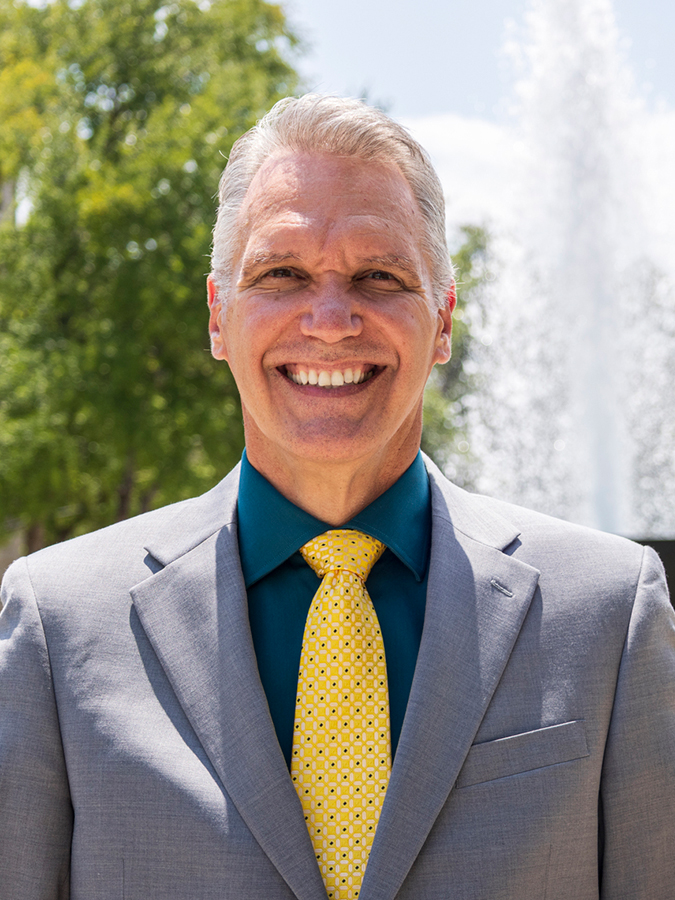
Michael Young, Ph.D., joined Baylor in August 2025 to serve as the Dean and Vice Provost of the Graduate School. He began his career as a computer scientist studying artificial intelligence before it was cool – and when it was a lot harder! In the middle of his computer science Ph.D. program at the University of Minnesota, he switched to the study of cognitive psychology, thus bridging his dual interests in quantitative modeling and cognition. He has capitalized on his programming skills to architect simple video games to study human decision making while also leveraging his background in machine learning to analyze data.
Dr. Young and his wife, Carolyn, met at the University of Illinois and lived throughout the Midwest (Ohio, Minnesota, Iowa, Illinois, and Kansas) before moving to Texas. They have three children, five grandchildren, and two barky dogs.
